
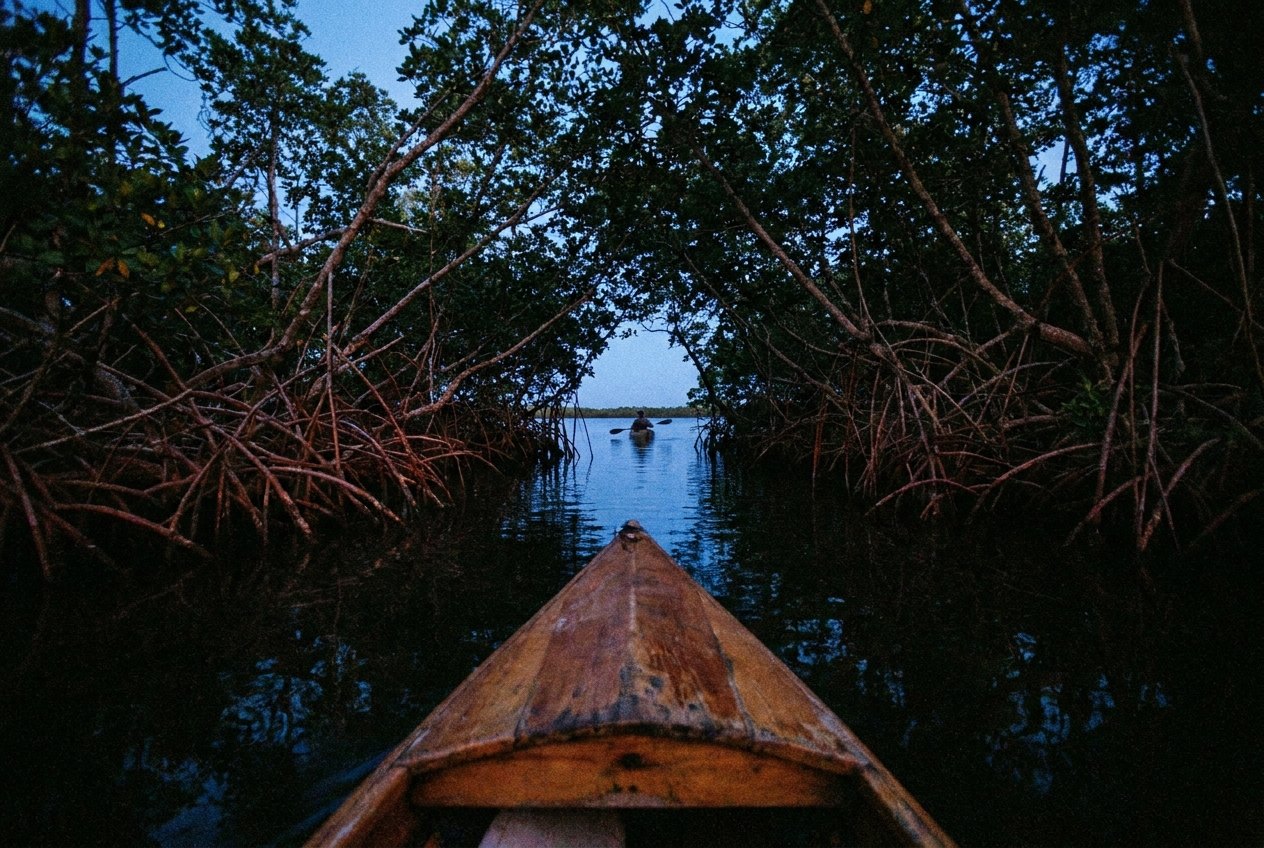
Laguna Grande is a lagoon within the Las Cabezas de San Juan nature reserve on the north-east tip of Puerto Rico, close to Fajardo. By day it looks like any calm, mangrove-fringed lagoon. At night, every movement in the water, a paddle stroke, a hand trailed over the side, a fish darting away, produces a faint blue-green light. It is one of three bioluminescent bays on the island, with Mosquito Bay on Vieques and La Parguera on the south-west coast.
What makes the water glow
The light comes from microscopic plankton called dinoflagellates. When the water around them is disturbed, they give off a brief flash of light through a chemical reaction. In most of the sea they are too scattered to notice, but in a few shallow, warm and sheltered lagoons, with a narrow mouth that limits the exchange of water and mangroves that feed them nutrients, they gather in huge numbers. The effect is strongest where the concentration is highest and the night is darkest.
The glow is not constant. It varies with the season, rainfall, water temperature and the health of the lagoon. Heavy rain, storms and pollution can dim it for weeks or months, and it has recovered from such dips before. Honest guides will tell you what to expect on the night you go.
The paddle
Most visits are by kayak, with a licensed guide, starting from the shore near Las Croabas in the early evening. The route leads through a narrow channel lined with red mangroves, whose arching roots and branches close over the water in places, and you paddle in the dark in single file. The channel opens into the lagoon, where the group gathers and the guide explains what you are seeing. The whole trip usually takes about two hours.
No experience is needed, but some effort is. The channel is narrow and has bends, and in a two-person kayak you must coordinate with your partner. Expect to get splashed. Small children, people with mobility problems and anyone uneasy on the water in the dark may prefer a boat tour where offered, or another bay.
ALSO ON THIS STRETCH OF WATERFajardo, the east coast's boating townTiming the moon
The darker the sky, the brighter the water appears. Plan for a night close to the new moon if you can, and avoid the nights around a full moon, when the lagoon can look disappointing. Cloud cover helps on a bright moon night. Sunset times change through the year, so tours run at different hours by season.
Protecting the lagoon
Bioluminescent bays are fragile. Swimming is not allowed in Laguna Grande, because body oils, sunscreen and repellent harm the organisms. Many guides ask visitors not to wear insect repellent or sunscreen on the night, so cover up with light clothing instead. Do not grab mangrove roots, which are the base of the lagoon's food chain and a nursery for young fish, and take everything you bring back out with you.
The lagoon is part of the Cabezas de San Juan reserve, which you can visit by day to see the mangroves, the dry forest and the old lighthouse. If you are heading out to the islands, compare it with Mosquito Bay on Vieques, which is larger and often brighter but requires a ferry or flight and a night on the island.