
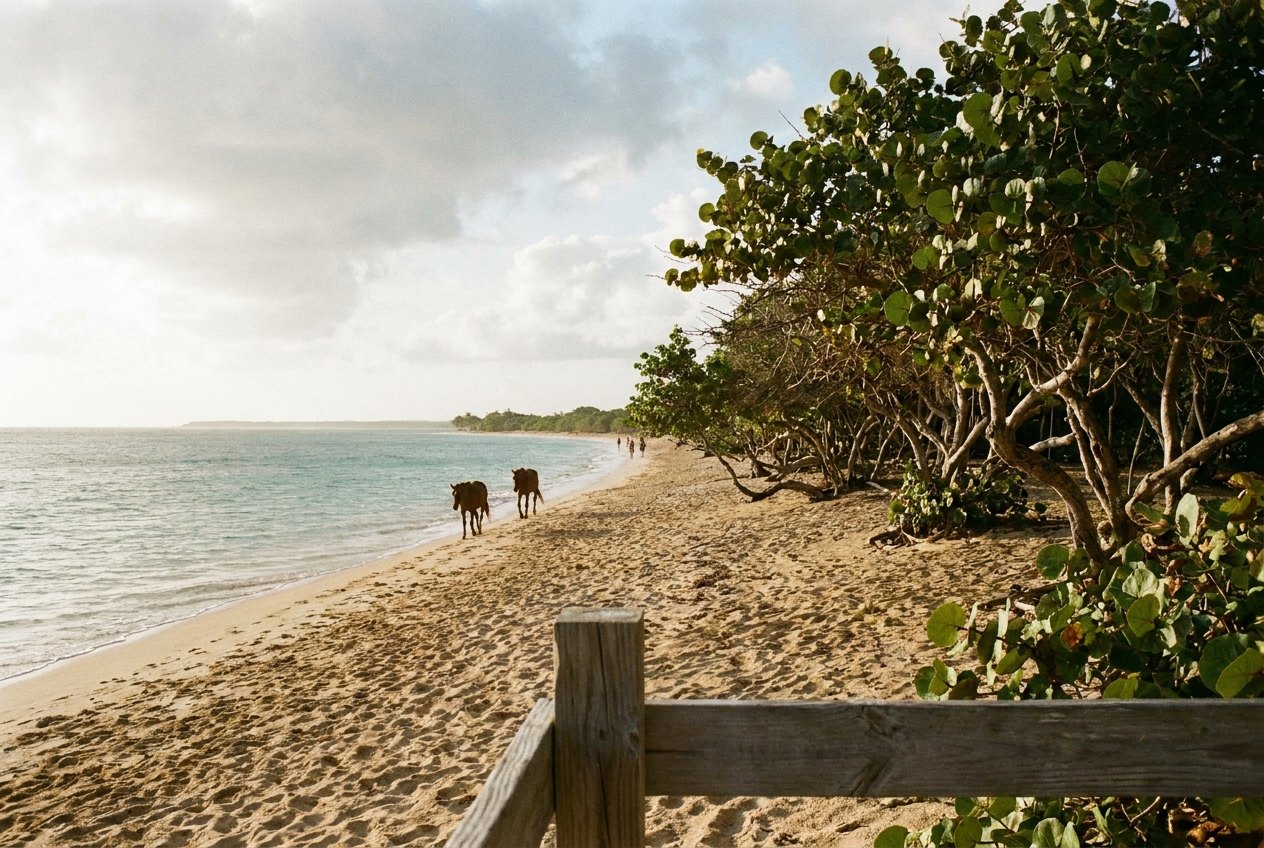
Vieques is the larger of Puerto Rico's two inhabited offshore islands, about 30 kilometres long, lying south-east of the main island. For much of the 20th century the United States Navy controlled most of it, using the west for storage and the east for training and bombing practice. After years of protest, the Navy left the west of the island in 2001 and the east in 2003. Most of its former land became the Vieques National Wildlife Refuge, one of the largest protected areas in the Caribbean, and its beaches, untouched by development for decades, opened to the public.
Sun Bay
Sun Bay, known locally as Sombé, is a long crescent of pale sand just east of Esperanza on the south coast. It is a public beach with parking and basic facilities, and its calm water and shade trees make it a favourite with families. Even on busy days, there is room to spread out. Horses often wander along the back of the beach.
The beaches of the refuge
The eastern part of the refuge is reached through a gate on the south side of the island, with dirt and paved roads leading to a series of beaches. Caracas Beach, also called Red Beach from its old military code name, is the best known: a sheltered cove of white sand and clear water with shade shelters. Nearby coves, also known by colours and names given during the military years, offer quieter spots.
Parts of the former bombing range remain closed because of unexploded ordnance and ongoing clean-up. Signs mark these areas. Stay on open roads and beaches and never pick up metal objects.
ALSO ON THIS STRETCH OF WATERMosquito Bay on Vieques after darkPlaya Negra
West of Esperanza, a short walk along a dry streambed leads to Playa Negra, a beach of black sand rich in iron minerals, washed down from the hills. The black sand stretches along a short section of the shore, a striking contrast with the island's usual white beaches. The walk is short but can be muddy after rain, and the sea here can be rough; it is a beach for looking rather than swimming.
The horses
Hundreds of horses roam freely across Vieques. Most belong to someone and carry brands, but they are allowed to wander, and they graze along roadsides, in town and on the beaches. They are part of the island's character and a favourite subject for visitors' photographs. Keep your distance, do not feed them, and drive slowly, especially after dark, when they are hard to see on unlit roads.
Isabel Segunda and the fort
The island's main town, Isabel Segunda, is on the north coast where the ferry docks. On a hill above it stands the Fortín Conde de Mirasol, a small fort built by the Spanish in the mid-19th century, often described as the last fort Spain built in the Americas. It now holds a museum of the island's history. The town also has a lighthouse, a central plaza and the island's main services.
Getting around
Vieques is too large and hilly to see on foot. Most visitors rent a car or jeep, or a golf cart for short distances; cars from the main island are often restricted on the ferries. Public transport is limited to shared vans. Book transport early in busy seasons. For crossing to the island, see our notes on the ferries and small planes, and for the reefs off its beaches, snorkelling the east coast.